
Choosing the Right Flat Roofing System for Your Commercial Property
Most commercial property owners in the Treasure Valley view their roof as a simple overhead expense until a leak disrupts operations. The reality is that your flat roof acts as the primary defense for your inventory and employees against Idaho’s extreme temperature swings.
We see the results of poor material selection every season.
A roof installed in Meridian has to withstand summer surface temperatures reaching 160 degrees and winter lows that drop well below zero. When you are ready to replace or install a flat roof, the market offers two primary contenders: TPO (Thermoplastic Polyolefin) and EPDM (Ethylene Propylene Diene Monomer).
Our team has installed miles of both materials across the region.
This guide breaks down the data, the differences, and the specific applications where each material wins.
What Is TPO Roofing?
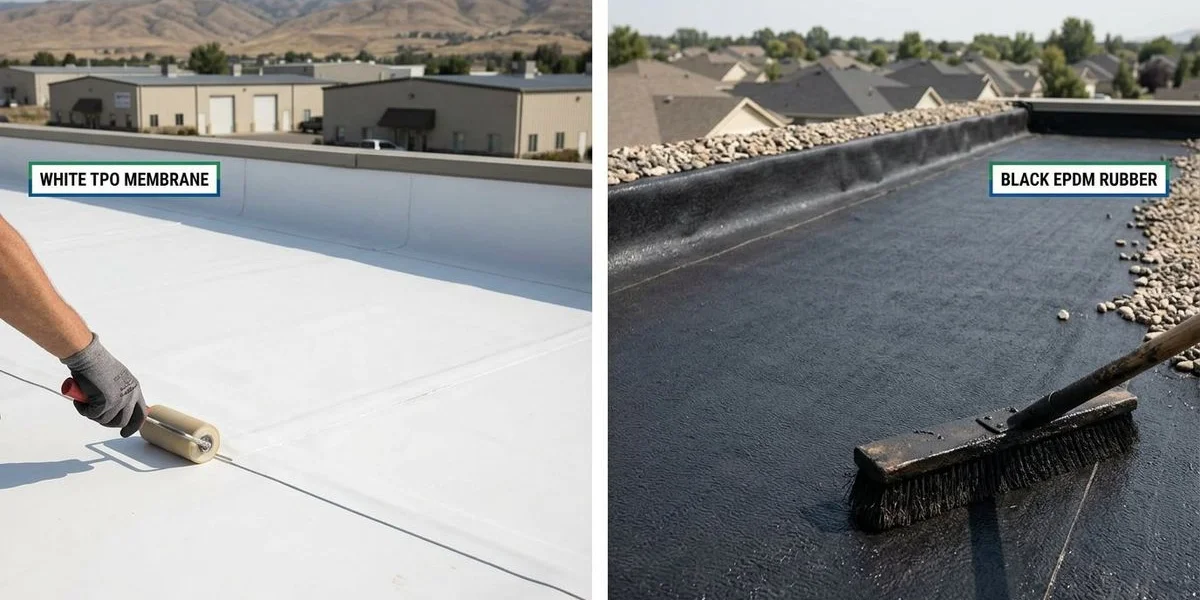
TPO is a single-ply roofing membrane composed of a blend of polypropylene and ethylene-propylene rubber. Manufacturers like GAF and Carlisle SynTec engineered this material to combine the durability of rubber with the heat-welding capability of plastic.
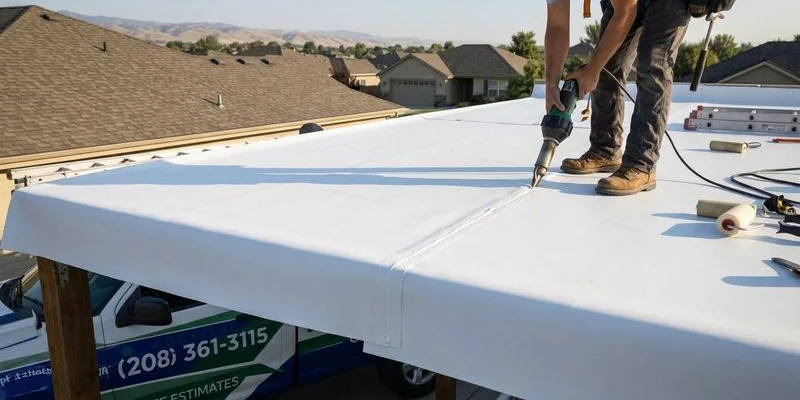
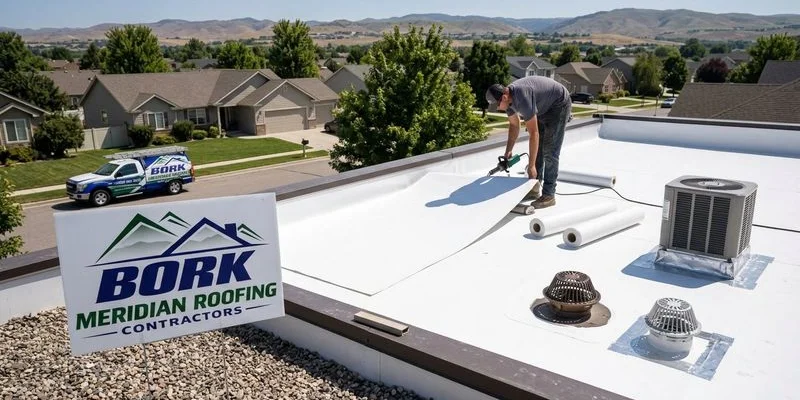
Installers roll these sheets out and fuse the seams with hot air to create a monolithic, watertight bond.
The material has seen a massive surge in popularity since the early 2000s. Current industry data suggests TPO now accounts for over 50% of the single-ply commercial roofing market. Its white, reflective surface is its defining feature, specifically designed to combat solar heat gain.
TPO Advantages
- High Solar Reflectance Index (SRI): TPO membranes typically hold an SRI score between 90 and 100. This reflectivity rejects UV rays and keeps the roof surface cooler, which directly reduces the load on your HVAC units during July and August.
- Welded Seam Integrity: The hot-air welding process heats the seam to roughly 1,000 degrees Fahrenheit. This fuses the two sheets into a single piece of material that is up to four times stronger than adhered seams found in other systems.
- Grease and Chemical Defense: TPO handles exposure to fats and oils better than many competitors. This makes it a smart specification for restaurants or facilities with rooftop ventilation that might discharge grease.
- Puncture Resistance: Modern TPO reinforced with polyester scrim offers excellent puncture resistance, generally testing around 250 to 300 pound-force (lbf).
TPO Drawbacks
- Heat Loading Issues: While the seams are strong, extreme heat loading over many years can cause the membrane itself to become brittle if a low-quality formulation was used.
- Variable Quality: Not all TPO is created equal. The chemical formulation varies significantly between manufacturers, so sticking to top-tier brands like Elevate (formerly Firestone) or Johns Manville is critical for longevity.
- Repair Complexity: You cannot simply patch TPO with glue. Repairs require a specialized heat welder and electric power, meaning you usually need a professional for even small fixes.
What Is EPDM Roofing?
EPDM is often referred to as the “rubber roof” and has served as a staple in the commercial sector since the 1960s. It is a thermoset membrane, meaning it is cured and hardened during manufacturing.
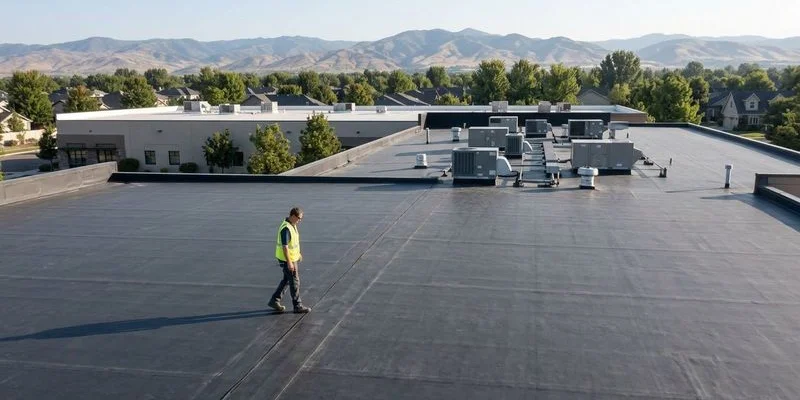
You will typically see this material in large black sheets that look and feel like an inner tube.
Contractors install EPDM by gluing it to the insulation (fully adhered), mechanically fastening it, or weighing it down with river rock (ballasted). While white EPDM exists, the carbon black formulation is far more common because the carbon adds UV stability and strength.
EPDM Advantages
- Extreme Elongation: EPDM can stretch up to 300% without breaking. This flexibility is vital in Idaho, where a building might expand and contract significantly during a freeze-thaw cycle in late winter.
- Proven History: We have seen EPDM roofs in the field that are still performing after 35 years. The material’s chemical structure is incredibly stable and does not degrade easily under UV light.
- Hail Impact Absorption: The rubber nature of EPDM allows it to absorb the shock of a hailstone. It typically achieves a Class 4 impact rating, meaning it resists cracking better than more rigid plastics.
- Simple Repairs: Maintenance teams can patch EPDM using pressure-sensitive tapes and primers. No heavy machinery or generators are required for basic patches.
EPDM Drawbacks
- Seam Vulnerability: EPDM sheets are bonded with adhesive tape or liquid glue rather than being heat-welded. These glues can degrade over 15 to 20 years, making seams the most common failure point.
- Shrinkage: The membrane has a tendency to shrink slightly as it ages. This can pull the material away from parapet walls and flashings, creating tension that eventually tears the perimeter seal.
- Heat Absorption: A black EPDM roof can reach surface temperatures of 170 degrees or higher on a sunny day. This heat transfers into the building, forcing your air conditioning to work harder.
Side-by-Side Comparison for Idaho Businesses
We compiled this data to help you visualize how these materials stack up against each other in real-world local conditions.
| Feature | TPO Roofing | EPDM Roofing |
|---|---|---|
| Installed Cost (Est.) | $5.50 - $8.50 per sq. ft. | $6.00 - $9.50 per sq. ft. |
| Primary Benefit | Energy Savings (Cool Roof) | Durability & Hail Resistance |
| Seam Technology | Heat-Welded (Fused) | Adhered (Glued/Taped) |
| Typical Lifespan | 20 - 30 Years | 25 - 40 Years |
| Surface Temp (Summer) | ~110°F | ~170°F |
| Repair Difficulty | High (Requires heat welder) | Low (Tape and primer) |
Analyzing the Cost
Market rates for 2025 and 2026 show TPO holding a slight price advantage.
The raw materials for TPO are generally less expensive to produce, and the rolls are often wider, which speeds up installation labor. EPDM prices fluctuate with the oil market and typically require more labor-intensive detailing at the seams and walls.
Energy Performance Realities
Meridian averages over 20 days a year above 95 degrees.
A white TPO roof reflects roughly 80% of that solar energy. For a 10,000-square-foot warehouse, this can translate into hundreds or thousands of dollars in annual cooling savings. EPDM absorbs that heat.
While some argue that black roofs help in winter, the data shows that winter days in Idaho are often overcast or the roof is covered in snow, negating any “heat gain” benefit from a black surface.
Durability in the High Desert
EPDM wins on pure longevity and hail resistance.
If your building is located in a hail belt or you plan to keep the property for 30+ years, the premium for EPDM pays off. However, if your primary concern is immediate ROI through lower utility bills, TPO is the clear winner.
Which Should You Choose?
The Case for TPO
You should prioritize TPO if your facility fits these criteria:
- Air conditioning is a major expense: You have a conditioned warehouse, office, or retail space.
- Visible Roof: The roof is visible from higher floors or adjacent buildings (white looks cleaner than black rubber).
- Restaurant or Processing: You need resistance to animal fats or grease output.
- Budget Driven: You need a high-performance system at the most competitive price point.
The Case for EPDM
We recommend EPDM for buildings with these specific needs:
- Hail Prone Area: You want maximum protection against storm damage.
- Long-Term Hold: You intend to own the building for decades and want a “set it and forget it” lifespan.
- High Movement: Your building structure is wood-framed or prone to shifting, requiring extra membrane flexibility.
- DIY Maintenance: You want your in-house maintenance staff to handle minor repairs easily.
A Third Option: Hybrid Approach
Smart property owners sometimes mix these technologies.
We can install TPO on the main field of the roof to maximize energy reflection. Then, we install EPDM pads or walkways around heavy HVAC units where mechanics frequently drop tools or walk on the surface. This gives you the durability of rubber where you need it and the energy savings of TPO everywhere else.
Working With a Qualified Commercial Roofer
The best material in the world will fail if the seams are not probed correctly or the perimeter flashing is loose. Installation quality dictates 70% of a roof’s success.
Our crews undergo manufacturer-specific training for both systems.
At Bork Roofing, our commercial roofing division understands the specific wind uplift requirements and code mandates for the Treasure Valley. We don’t just sell one product; we look at your building’s usage and recommend the right tool for the job.
Get a Free Commercial Roof Assessment
Identifying the right system starts with a look at your current deck and insulation.
Contact our team today for a comprehensive roof assessment. We will provide a clear, data-backed comparison of TPO and EPDM options tailored specifically to your Meridian property’s needs and budget.