
How Do You Know When It Is Time for a New Roof?
Your roof handles a massive workload in silence. Day after day, it battles Idaho’s scorching summer UV rays, freezing winter nights, and the occasional severe hailstorm. No material lasts forever.
We know from experience that waiting until water drips into your living room usually means the damage is already extensive.
This delay often turns a manageable repair into a costly renovation.
Our team has inspected hundreds of properties across Meridian and the Treasure Valley. We see exactly what happens when local homeowners miss the early warning signs. The 2026 Cost vs. Value Report data indicates that a timely roof replacement recovers a significant portion of its cost in home value.
Catching these issues early is your financial safeguard. Most of these red flags are visible right from your driveway or a quick peek into the attic.
Here are the seven specific indicators every Meridian homeowner needs to watch for.
1. Curling or Buckling Shingles
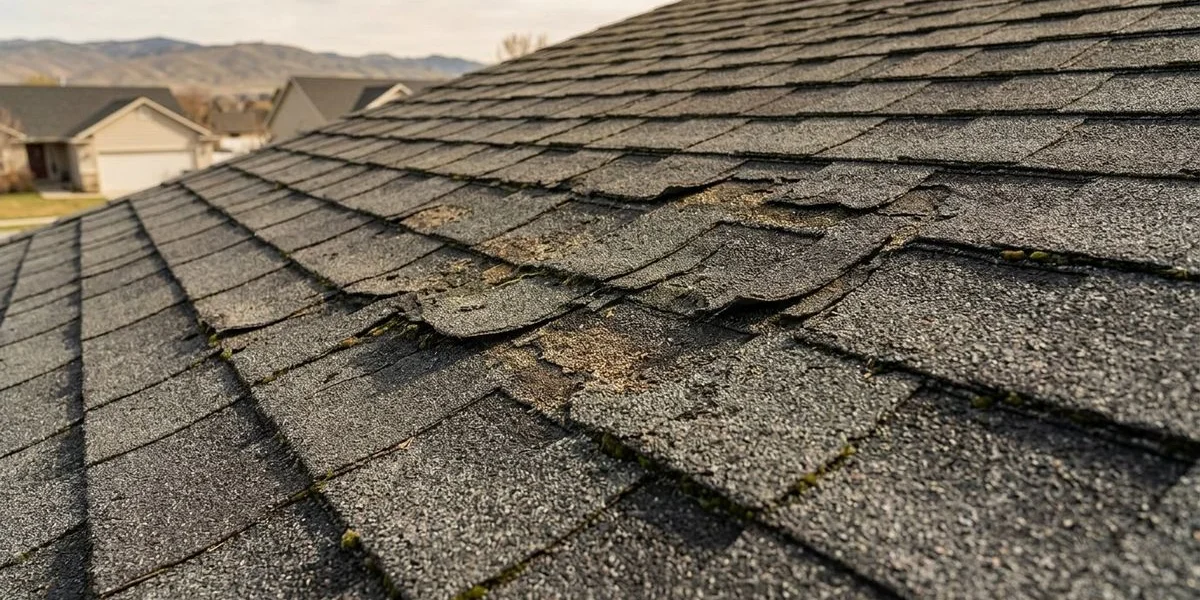
Asphalt shingles are designed to lie flat to create a watertight seal. When they start curling at the edges (cupping) or buckling in the middle (clawing), that seal is broken.
We frequently see this occur after 15 to 20 years of exposure to the intense “thermal shock” common in our region. This happens when roofing materials expand in the summer heat and rapidly contract during cool desert nights. Once a shingle curls, it becomes brittle and highly susceptible to wind uplift.
Take a moment to walk around your property this weekend. Look at the roof slopes that get the most direct sunlight.
Check for these specific deformations:
- Cupping: The edges of the shingle turn upward while the center sinks.
- Clawing: The middle of the shingle pushes up while the edges stay flat.
- Cracking: Visible fissures running through the asphalt layer.
If you spot these issues, the material has lost its flexibility. It is time to call a professional for an inspection.
2. Missing or Cracked Shingles
High winds in the Treasure Valley frequently gust between 40 and 50 mph. These forces can easily tear older shingles right off the deck.
We advise checking your yard immediately after any major wind event. Finding shingles on the lawn means your roof’s “armor” has a gap, leaving the underlayment and wood deck exposed to rain and snow. Even if the shingles are still attached, look for horizontal cracks near the top.
These fractures, often called “wind creases,” are a clear sign the sealant strip has failed.
The Hidden Danger of Exposed Decks:
- UV Degradation: The sun eats away at exposed underlayment in days.
- Water Infiltration: Rain wicks sideways under surrounding shingles.
- Rot Risk: Moisture gets trapped against the plywood decking.
Replacing a few tabs is a simple fix. But if the damage is widespread or the remaining shingles are too brittle to manipulate, a full roof replacement is the smarter financial move.
3. Granule Loss in Your Gutters
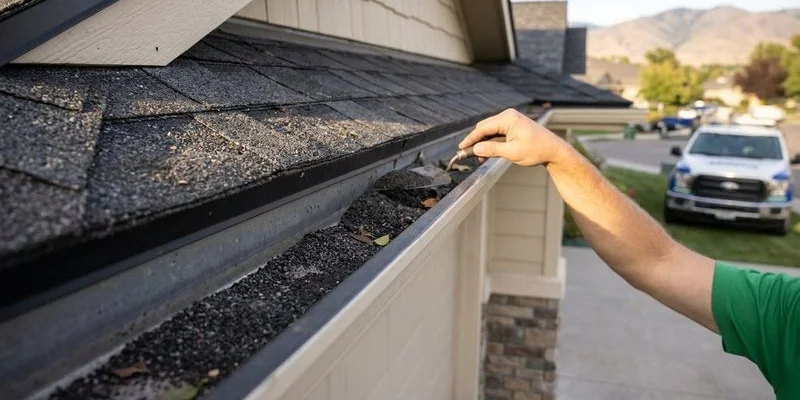
Asphalt shingles rely on a coating of ceramic-coated mineral granules. These tiny stones block UV rays and provide fire resistance.
Our inspectors look for “balding” shingles as a primary indicator of roof age. Over time, the adhesive holding these granules fails, and they wash away during rainstorms.
Where to look:
- Gutters: Check for piles of black, sand-like sediment.
- Downspouts: Look for accumulation at the splash block.
- Shingle Surface: Scan for dark, smooth patches where the asphalt is exposed.
Some granule loss is expected on a brand-new roof as excess material washes off. However, if your roof is over 10 years old and your gutters are full of grit, the shingles are deteriorating rapidly. Exposed asphalt dries out quickly in the Idaho sun, leading to cracks and leaks.
4. Sagging Roof Deck (Do Not Ignore This One)
This is the most critical structural warning sign on this list. A straight roofline is a healthy roofline.
We treat any dipping or waviness as an emergency. A sagging deck usually implies that the plywood or OSB sheathing underneath is rotting due to long-term moisture exposure or poor ventilation.
Safety Warning: If you see a sag in your roof, do not walk on it. The decking may be soft and could collapse under your weight. Contact a professional immediately.
In our area, this issue is often exacerbated by snow loads. One inch of ice creates as much weight stress as a foot of fresh snow. If the decking is already weakened by moisture from attic condensation, a heavy winter storm can lead to partial collapse.
Common Causes of Deck Sag:
- Inadequate Ventilation: Traps moisture in the attic during winter.
- Layering: Installing new shingles over old ones adds too much weight.
- Leakage: Long-term water intrusion rots the wood fibers.
5. Daylight Visible Through the Roof Boards
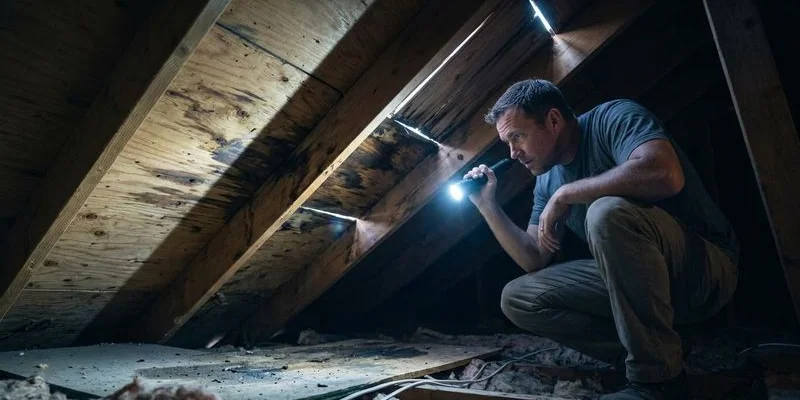
Your attic offers one of the best vantage points for checking roof health. Pick a bright, sunny day to head upstairs.
We recommend turning off all attic lights and waiting for your eyes to adjust. If you see pinpoints of light shooting through the roof boards, those are direct pathways for water. We call these “starbursts,” and they often indicate where shingles have worn through or where flashing has pulled away.
While you are up there, inspect the decking for:
- Dark Stains: Evidence of water soaking into the wood.
- White Mold: A sign of poor ventilation and high humidity.
- Rust: Check the nails poking through the deck; rusty tips indicate moisture.
This check is vital after spring hailstorms. Small hail punctures are hard to see from the street but show up clearly as light leaks from inside the attic.
6. Rising Energy Bills
Your roof is a primary component of your home’s thermal envelope. If it fails, your HVAC system has to work overtime.
We often trace unexplained spikes in heating or cooling costs back to the attic. When insulation gets wet from a small leak, its R-value (thermal resistance) drops significantly. Additionally, failing roof ventilation can trap superheated air in the summer, baking your home from the top down.
The Impact of a Healthy Roof System:
| Feature | Old/Failing Roof | Modern Roof System |
|---|---|---|
| Attic Temperature | Can reach 150°F+ in summer | stays closer to outside temp |
| Insulation Efficiency | Compromised by moisture/dust | Protected and dry |
| HVAC Load | Runs constantly to compensate | Cycles normally |
| Airflow | Static, trapped air | Continuous intake/exhaust |
Department of Energy studies suggest that a properly ventilated and insulated “cool” roof system can reduce cooling costs by 10-15%. A new roof with modern underlayment stops these energy leaks, keeping your conditioned air where it belongs.
7. Your Roof Is Over 20 Years Old
Age is the ultimate factor. Even a roof that looks okay from the street has a finite lifespan.
We find that standard 3-tab asphalt shingle roofs in the Treasure Valley typically last 20 to 25 years. Architectural shingles may last closer to 30 years. However, proper installation and attic ventilation are the real variables that determine longevity.
The “Boom” Era Homes: Many homes in Meridian were built during the rapid expansion between 2000 and 2005.
If your home falls into this age bracket, your original roof is likely at the end of its engineered life. The sealant strips lose adhesion, and the asphalt loses flexibility.
Planning ahead is always cheaper than reacting to a disaster. Scheduling an inspection at the 20-year mark allows you to budget for a replacement on your own timeline, rather than being forced into it by a leak during a storm.
What to Do If You Notice These Signs
Identifying these signs is the first step toward protecting your home’s value. If you spotted curled shingles, granule loss, or daylight in the attic, you need professional verification.
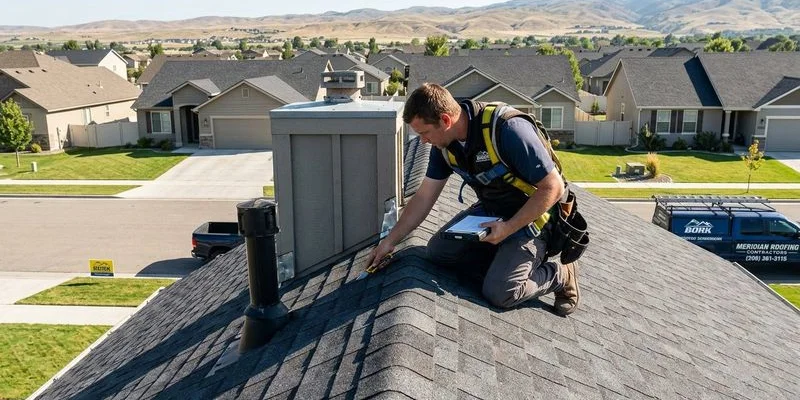
We believe in giving you the raw data so you can make an educated decision. A qualified contractor will assess the decking, flashing, and ventilation to provide a comprehensive report.
Our Process at Bork Roofing:
- Full Assessment: We check every component, not just the shingles.
- Honest Reporting: We tell you if a repair will suffice or if replacement is necessary.
- Local Expertise: We serve Meridian, Eagle, Nampa, Caldwell, and the entire Treasure Valley.
Ignoring these signs rarely ends well. Water damage spreads fast and costs more to fix the longer it sits. Schedule your free inspection today to get a clear picture of your roof’s condition and peace of mind for the seasons ahead.