
Hail Damage Is Not Always Obvious
Most homeowners make a quick assessment from the driveway after a storm passes. You look up, see that the shingles are still attached, and assume your roof escaped unharmed.
The reality is quite different.
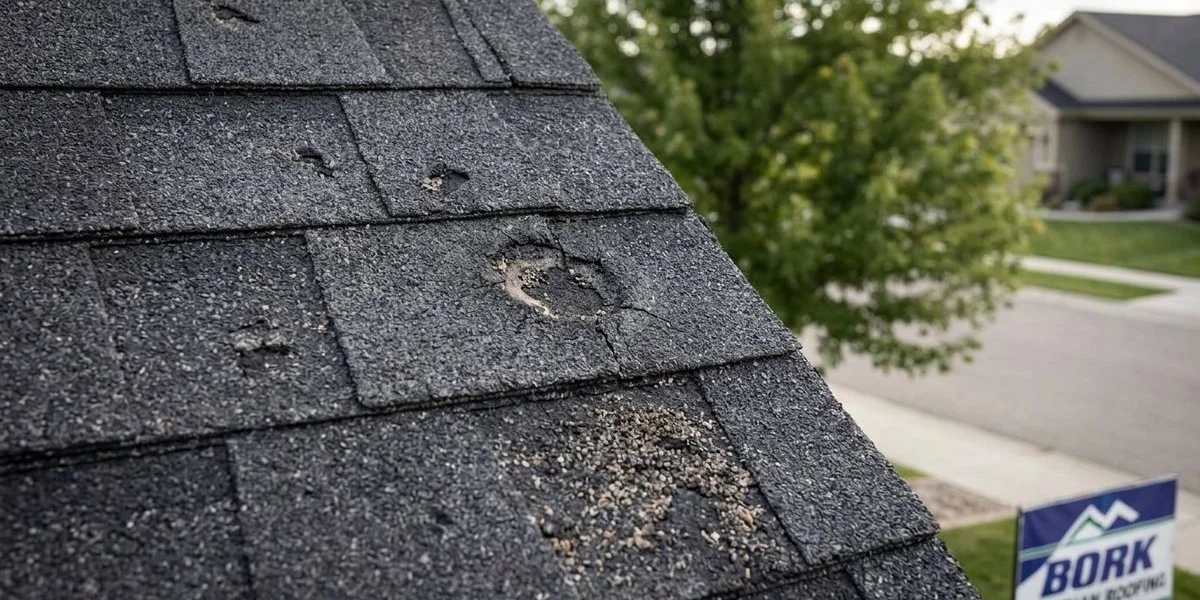
Significant hail damage to asphalt shingles is rarely visible from the ground level. The real destruction happens microscopically and structurally where the ice impact compromises the water-shedding surface.
Our team has seen countless roofs that looked perfect from the street but were actually totaling losses upon closer inspection. Understanding the subtle indicators of damage helps you make informed decisions about repairs and insurance claims.
Here are the five verifiable signs that your roof has been compromised.
1. Random Dents and Bruising on Shingles
The most frequent indicator of hail damage is a pattern of bruises or dents scattered across the roof. Unlike foot traffic or installation errors, which follow a path, hail damage appears randomly.
We look for distinct soft spots on the shingle itself. These bruises indicate that the underlying fiberglass mat has fractured beneath the granules.
A fractured mat creates a weak point. Over time, water penetrates this fracture and reaches the roof deck.
The “Touch Test” for Bruising
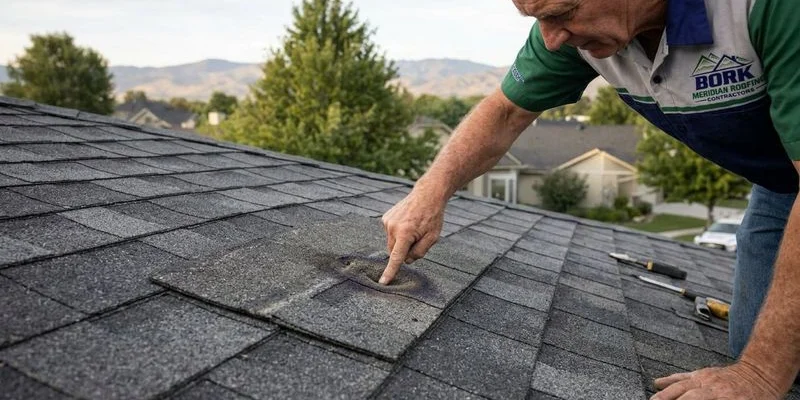
You usually cannot see these bruises without close examination. Our inspectors physically press on the shingles to find them.
A damaged area feels spongy or soft, similar to the skin of a bruised apple. Undamaged shingles remain rigid and hard.
This bruising is critical because it permanently lowers the shingle’s impact resistance. While you might catch a glimpse of small dimples when the sun hits the roof at a low angle, a tactile inspection is the only way to be 100% sure.
2. Granule Loss at Impact Sites
Asphalt shingles rely on a top layer of ceramic granules for protection. These granules block UV rays and provide necessary fire resistance.
Hail impact knocks these granules loose. This exposes the black asphalt substrate to the elements.
We always check the gutters first when investigating a roof. If you find a pile of mineral granules in your downspout splash blocks after a storm, it is a strong indicator of roof trauma.
Identifying the Impact Marks
On the roof, this damage looks like dark, round spots. The exposed asphalt creates a “polka dot” effect against the lighter-colored granules.
This differs significantly from normal aging.
| Feature | Hail Damage | Normal Wear & Blistering |
|---|---|---|
| Pattern | distinct, round spots with exposed asphalt | General thinning over wide areas |
| Location | Randomly scattered | Often on south-facing or poorly ventilated slopes |
| Texture | Embedded granules around the hit | Raised bubbles or rash-like texture |
The Consequence of Granule Loss
Exposed asphalt deteriorates rapidly. The sun’s UV rays dry out the oils in the shingle mat once the protective granules are gone.
Our experience shows that shingles with significant granule loss become brittle and crack much faster than intact shingles. This acceleration of the aging process often reduces a roof’s lifespan by five to ten years.
3. Cracked or Fractured Shingles
High-velocity impact from larger hailstones can snap the shingle entirely.
We typically see this occur with hailstones that are one inch (quarter size) or larger. The force is enough to break the fiberglass reinforcement within the mat.
You should look for these specific fracture types:
- Circular Fractures: Star-shaped cracks radiating from a central impact point.
- Horizontal Splits: Clean breaks running parallel to the roofline.
- Sheared Edges: Corners of the shingles that have broken off completely.
The Weather Factor
These cracks are immediate entry points for moisture. In regions with freeze-thaw cycles, water seeps into these fissures during the day and freezes at night.
The expanding ice widens the crack. This cycle turns a minor fracture into a major leak within a single winter season.
4. Dented Roof Vents, Flashing, and Gutters
Shingle damage often requires a trained eye, but metal damage is obvious to almost anyone.
We use the condition of metal components to gauge the severity of the storm. If the metal is dented, the shingles likely took a beating as well.
Check these specific metal areas:
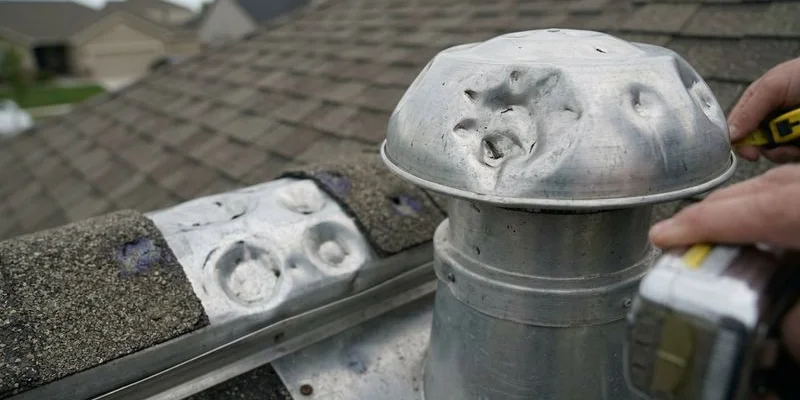
- Roof Vents: Box vents and turtle vents often show clear depressions.
- Chimney Flashing: The metal collar around the chimney is a prime target.
- Valley Metal: The flashing in the “V” where roof slopes meet.
Insurance adjusters rely heavily on this “collateral damage.” It serves as forensic evidence that a hail event occurred recently.
You can spot this from the ground using a simple trick. Shine a flashlight beam parallel to your downspouts or gutters; the shadows will reveal dents that are invisible in direct sunlight.
5. Damaged Soft Metals on the Roof
Soft metals provide the most definitive proof of hail size and density.
These materials deform instantly upon impact. We inspect lead pipe boots, aluminum ridge vents, and passive air vents to read the story of the storm.
A lead pipe boot (the flashing around your plumbing pipes) acts like a recording device.
Reading the Dents
Multiple round distinct dents in a lead boot confirm hard hail impact. The diameter of the dent often correlates directly to the size of the hailstone.
Insurance carriers use this data to determine if the storm was strong enough to warrant a full roof replacement. Spatter marks—clean spots on oxidized metal where hail hit—also prove the timing of the storm, which helps distinguish recent damage from old incidents.
What Does Your Insurance Adjuster Look For?
Adjusters follow a strict protocol to validate a claim. They need measurable data to justify paying for a new roof.
We work with adjusters daily and know exactly what metrics they require.
The “Test Square” Standard
The industry standard involves marking off a 10-foot by 10-foot area (one “square”). The adjuster counts the number of verifiable hail hits within this box.
- Hit Density: Most policies require 8 to 10 distinct hits per test square to approve that slope for replacement.
- Directionality: They check multiple slopes (North, South, East, West) to see which direction the storm came from.
- Functional Damage: They distinguish between cosmetic issues and functional damage that affects the roof’s water-shedding ability.
If the count meets the threshold on multiple slopes, the carrier typically considers the roof a total loss.
What Should You Do If You Suspect Hail Damage?
Speed is your best asset after a storm. Most insurance policies place a time limit on filing claims, often one year from the date of loss.
Many homeowners in the Treasure Valley and across the US sit on damage until a leak appears. By then, the internal wood rot may be extensive, and the insurance filing window may have closed.
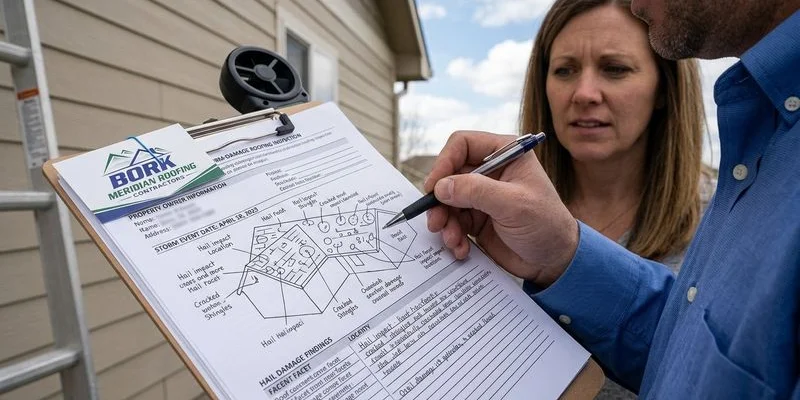
At Bork Roofing, we provide free storm damage inspections to give you a clear baseline. We generate detailed reports that document the damage with photos and diagrams, giving you the evidence you need for a valid claim.
Ignoring the signs usually leads to more expensive repairs down the road. Schedule your free inspection today so you can know the truth about your roof’s condition.